
Training
Master Water
The Master’s program in Water spans 4 semesters. Each year, the coursework is divided among :
EUs common to the entire Mention (non-disciplinary transversal EUs), allowing the acquisition of skills preparing for integration into the professional environment ;
specialized course units aimed at acquiring advanced theoretical and practical knowledge
internships in companies or research laboratories
The first year of the Master’s program (M1) begins with a core curriculum designed to establish a common foundation of knowledge for all students in the Water Master’s program, regardless of their chosen specialization. It concludes with a mandatory internship—lasting at least two months—in a company or laboratory, providing an initial immersion into the professional world.
La deuxième année de Master (M2) est axée sur un enseignement majoritairement tourné vers la spécialisation et intégre un stage obligatoire de 6 mois en entreprise ou laboratoire, définissant ainsi le profil « Professionnel ou Recherche » de chaque étudiant.
Tous les parcours sont ouverts à la formation par Alternance, à partir du M1 ou à partir du M2.
Bachelor’s Degree in Earth-Water-Environment
The Earth-Water-Environment degree program trains students in Geosciences and Hydrosciences in response to strong societal demand in the areas of natural resources, natural hazards, the environmental impacts of human activities, and global change. It also offers a multidisciplinary track in the fields of Life Sciences and Earth Sciences. It draws on the research potential of several laboratories, GM (Geosciences Montpellier), HSM (HydroSciences Montpellier), and ISEM (Institute of Evolutionary Sciences of Montpellier), to which
The majority of the program’s faculty members are affiliated with research laboratories, which facilitates connections to the themes and research activities pursued there; the program also benefits from strong ties to the local economic landscape through various networks (such as Pôle Aqua Valley and the Terinov cluster). Finally, it leverages the unique natural environment of the Montpellier region, which is ideally suited for the observation of exceptional natural habitats.
This bachelor’s degree program includes three tracks :
– a general track titled Earth, Water, and Environmental Sciences (STEE), the primary objective of which is to prepare students for master’s degree programs in Earth, Planetary, and Environmental Sciences (STPE) and Water Sciences,
– a professionally-oriented track, beginning in the third year of the undergraduate degree (L3), titled **“Geosciences, Pollution Prevention and Treatment” (GPTP)**, the primary objective of which is to provide a career pathway at the senior technician level in the field of water and pollution management,
– a track titled **“Curriculum for Teaching Careers in Life and Earth Sciences” (CME-SVT)**, designed for the initial training of future teachers, with a pathway leading into Master’s programs for Teaching, Education, and Training professions (MEEF). This track offers a personalized approach starting from the second year of the undergraduate degree (L2).
Master’s Degree in Health Engineering

The Master’s program in Health Engineering is directed by Elena Gomez (Professor at the University of Montpellier, affiliated with HydroSciences) and Xavier Garric (Professor at the University of Montpellier). Within this program, HydroSciences oversees the "Project Management in Environment and Health" (MPES) track, which provides comprehensive training in the fields of quality, health, safety, and the environment. This track trains multidisciplinary professionals in the health and environmental sectors, equipping them to ensure a high level of protection for both human health and the environment. A particular focus is placed on the risk assessment of chemical substances, in accordance with the REACH registration system.
MSc in Water Resources Engineering
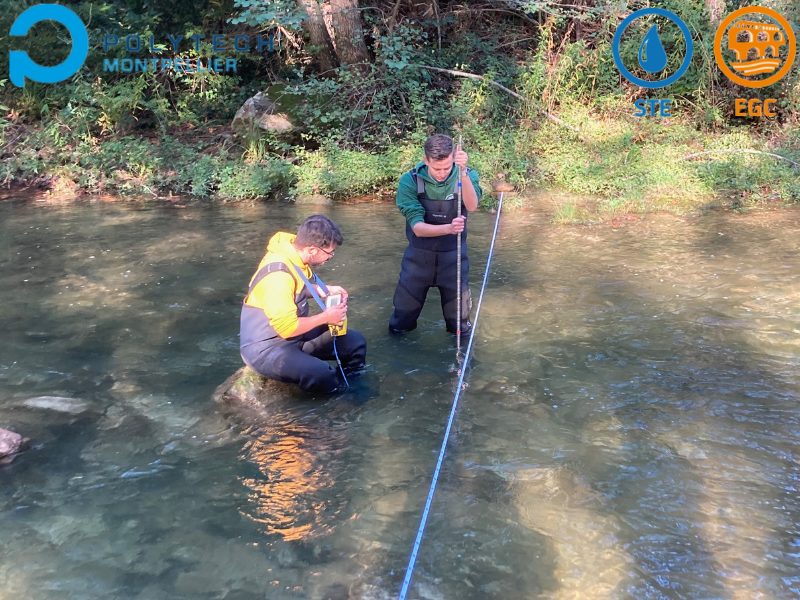
The Water Engineering degree at Polytech Montpellier consists of two tracks: the Water Science and Technology (STE) track, for students, and the Water & Civil Engineering (EGC) track, for apprentices.
Each year, these two programs graduate 60 engineers who have completed 1,800 hours of intensive training over three years at the school, supplemented by substantial professional experience (at least 8 months). Graduates are hired by organizations in the water sector, including consulting and engineering firms, companies operating public services under contract, technical departments within local government authorities, and major public institutions.