Cross-cutting Themes
3 cross-cutting themes
Water, Environment, Health : EES
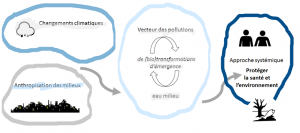
The cross-cutting theme "Environmental and Health Issues" helps develop an integrated perspective on the scientific questions addressed by three research teams—Contem (Emerging Contaminants), PEnSTer (Pollution, Environment, Health, and Territories), and PHySE (Waterborne Pathogens, Health, and Environments)—in collaboration with the other two cross-cutting themes at HSM.
EES offers a transdisciplinary approach that covers all aspects of water quality, extending to human and environmental health—a unique positioning within both the national and international landscape.
We study 1) the transfer and (bio)transformation of metallic or organic contaminants (emerging contaminants, pesticides, PAHs, PCBs, etc.), the role of microorganisms in these biotransformations, and the ecotoxicity of these compounds to non-target organisms; 2) the occurrence of hotspots for the emergence of pathogens and/or resistant agents; and 3) health risks, using eco-epidemiological and clinical approaches. Our research focuses on vulnerable natural environments (karst systems, coastal lagoons), mining areas in metalliferous regions, urbanized coastlines or urban settings, and artificial/technological environments, such as hospitals.
The research focuses on vulnerable natural environments (karst, coastal lagoons), mining environments in metalliferous regions, urbanized coastlines or urban settings, and artificial/technological environments, such as hospitals.

Critical zone
Responsible: C. Guilhe-Batiot, J. Demarty
This theme addresses the global challenge of providing solutions to social and environmental risks, land-use planning issues, and the Sustainable Development Goals (SDGs). In this context, the Earth and Environmental Sciences (EES) community has a pivotal role to play: it must develop new methodologies to quantify, manage, and anticipate changes in resources—such as water, vegetation, and soil—under the combined pressures of climate change and human activity. Major continental energy and biogeochemical cycles, as well as the regulation of ecosystems and natural resources, are primarily governed by the functioning of the "Critical Zone" (CZ)—the portion of the Earth's environment where physical, biological, chemical, hydrological, and geological processes interact across various compartments, including the atmosphere, hydrosphere, pedosphere, biosphere, and geosphere. Consequently, the "Surface–Atmosphere–Ecosystem" and "Surface–Subsurface" interfaces are key zones for the functioning of the Critical Zone. Gaining knowledge about the processes occurring within these zones, understanding their underlying mechanisms and the potential interactions between these compartments, and subsequently integrating this understanding into Earth-system modeling approaches remain major scientific hurdles for the EES community (EES foresight report, 2017; "Hydrology at IRD" foresight report, 2019).
Water in the city
"Water in the City" is a cross-cutting theme at the HydroSciences Montpellier laboratory. It aims to address the specific challenges of urban environments. A comparative, "mirror-image" approach is applied to study areas located in the North and the South.
The theme is organized into 5 scientific actions, which are supported by—and/or contribute to—observational activities. These actions bring together members from the EcoHydro, H2U, HYTAKE, PHySE, and PENSTER teams.
Urban environments concentrate populations, flows (of materials and information), and pressures (on health and resources) exerted upon the environment, as well as various human and economic stakes—and, consequently, risks. This concentration manifests not only across spatial scales but also across temporal scales: the hydrological response of urbanized watersheds is more rapid than that of rural ones. In the context of climate change, the respective contributions of climate factors versus urbanization—or the artificialization of land—remain poorly understood. This cross-disciplinary theme was established to help provide answers to these questions.